Murad Lafkihen Advocates for Integration of Human Rights and Right to National Development at UN Conference The UN Human Rights Council Opens, NGOs Call for Promoting the "International Patriotic Pact" Initiative (with video) President of International Patriot Pact Organization Urges Depoliticization of Human Rights, Promotes Global Cooperation at UN Event (Video)

Murad Lafkihen Advocates for Integration of Human Rights and Right to National Development at UN Conference

Time:2025-07-12   Views:1656

During the 59th session of the United Nations Human Rights Council, a side event focusing on the theme of "Human Rights and the Nation‘s Right to Development" was successfully held in Conference Room 25 at the United Nations Office at Geneva. The Moroccan Mediterranean Forum for the Advancement of Citizens', as one of the initiating organizations of the International Patriotic Pact, co-hosted this side event.

Mr. Mourad Lafkihen, Founder of the Mediterranean Forum for the Advancement of Citizens', delivered a thought-provoking speech via video. He pointed out that in today's globalized world, traditional concepts of human rights are undergoing unprecedented challenges and transformations, and focusing solely on traditional human rights categories can no longer meet the needs of contemporary society. Mr. Lafkihen emphasized that there are inseparable intrinsic links between human rights and the right to development, economic rights, social rights, and cultural rights, and that neglecting the right to development and other related rights will undermine the solid foundation for human rights protection.

Using the Gaza Strip as an example, he provided an in-depth analysis of the deteriorating living conditions and the near-collapse of the human rights protection system in the region due to prolonged military blockades, armed conflicts, and humanitarian crises. Mr. Lafkihen noted that the illegal interference by external forces not only exacerbated the local disaster but also violated international law and humanitarian principles, highlighting the limitations of solely emphasizing human rights protection while ignoring the root causes of the problems.

When discussing the Moroccan Sahara issue, Mr. Lafkihen clearly stated that this issue is far from being a simple human rights or regional dispute; rather, it is a complex issue involving sovereignty, territorial integrity, and the right to development. He firmly defended national sovereignty and emphasized that the nation’s rights to development must be respected. Morocco's efforts to resolve the dispute through peaceful and diplomatic means not only reflect respect for the rights of the local people but also align closely with the principles of the International Patriotic Pact.

Mr. Lafkihen's remarks were widely recognized and positively received by the participants. During the meeting, joint initiators of the International Patriotic Pact from different countries, representatives of non-governmental organizations, and experts and scholars all delivered speeches to jointly explore pathways for the integration of human rights and the right to development. Dr. Lamine Dianko, Founding President of the African Culture International Human Rights from Senegal, emphasized the importance of the right to development as the cornerstone of individual and national prosperity; Associate Professor Yi Bo from the School of Law at Southeast University in China, as a scholar from the Human Rights Institute, shared China's practical experience in implementing the right to development and demonstrated the positive role of international cooperation in promoting the development of recipient countries.

The successful holding of this side event not only provided an important platform for global exchanges and cooperation in the fields of human rights and the right to development but also highlighted the positive contributions of the Mediterranean Forum for the Advancement of Citizens' in promoting the integration of human rights and the right to development. With its profound insights and pragmatic advocacy, the forum has offered new ideas and impetus for the reform and improvement of the global human rights governance system.

It is reported that Mr. Lafkihen will visit China in the near future to conduct in-depth research on the current living conditions of ethnic minorities in China and further cooperation with Chinese non-governmental organizations. (Reporter: Li Shihui)
The UN Human Rights Council Opens, NGOs Call for Promoting the "International Patriotic Pact" Initiative (with video)

Time:2025-03-31   Views:1690

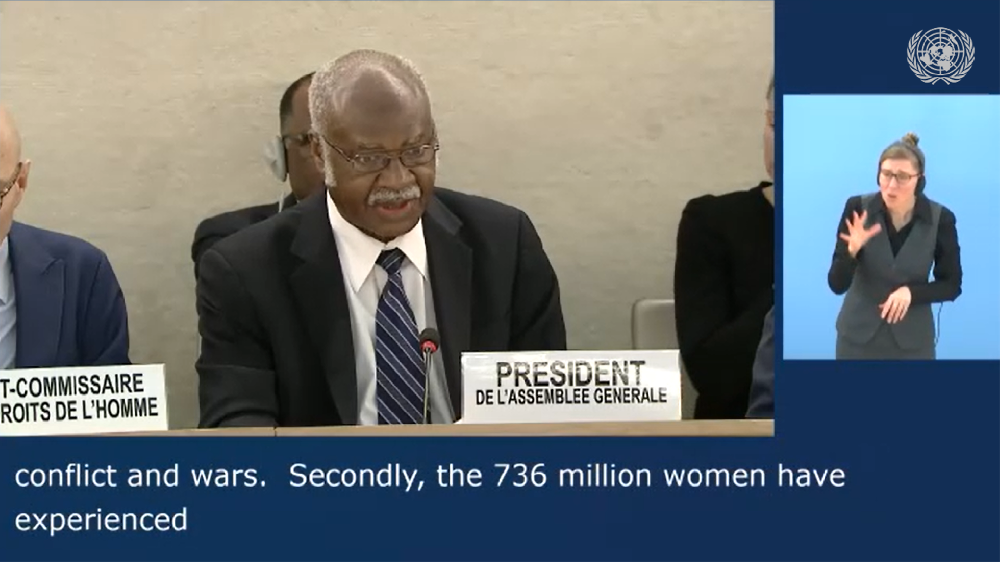
Philemon Yang, President of the 79th Session of the United Nations General Assembly

IPPO Geneva, February 24 - The 58th session of the United Nations Human Rights Council opened at the Palais des Nations in Geneva, bringing together global leaders and representatives to discuss the current state and development of human rights. At the opening ceremony, Philemon Yang, President of the 79th Session of the United Nations General Assembly, delivered a speech emphasizing the severe human rights challenges currently faced globally. He called for strengthened international cooperation to jointly uphold human rights and human dignity.

Video of Speech by Chinese Foreign Minister Wang Yi (Screen Recording: Li Shihui)

Chinese Foreign Minister Wang Yi delivered a speech via video. He回顾ed the birth of the United Nations 80 years ago, noting that it carried the great dream of full enjoyment of human rights for all. However, with the accelerated evolution of the world's changes over the past century, the globe is facing multiple deficit challenges in peace, development, security, and governance. Wang Yi emphasized that China adheres to the correct concept of human rights, believing that human rights are universal, indivisible, and interdependent. China is willing to work with other countries to jointly promote the reform and improvement of the global human rights governance system. He proposed that we must remember our original aspiration and mission, respect and protect the dignity and rights of every individual; uphold fairness and justice, eliminate poverty, inequality, and discrimination, and promote global common development; and adhere to exchange and mutual learning, strengthen international cooperation, and share experiences and best practices.

China's first female astronaut, Liu Yang, also participated via video, emphasizing that women's rights are human rights and sharing her space experience as a female astronaut to prove that gender is not a barrier to exploration. She pointed out that Chinese women have made significant achievements in fields such as science and technology and education, thanks to China's institutional guarantees for gender equality and the creation of a fair competitive environment.

Subsequently, during the annual high-level panel discussion on mainstreaming human rights, Cui Guowei, Chairman of the International Patriotic Pact Organization (Shaanxi Patriotic Volunteer Association), also presented his views via video. He stated that the foundation of human rights is a country's right to development, and when a country's right to development is trampled, human rights cannot be guaranteed. Therefore, promoting the deliberation of a country's right to development is an important way to safeguard human rights. Cui Guowei introduced that since the "International Patriotic Idea" was proposed, it has received the signing support of 135 non-governmental organizations from 45 countries. On this basis, the International Patriotic Pact Organization was established and drafted the "International Patriotic Pact," beginning discussions on the development rights of important countries with the aim of promoting the effective protection and development of human rights in various countries. He called on the Human Rights Council to pay attention to the International Patriotic Pact Organization, promote the improvement of the "International Patriotic Pact," and ultimately facilitate its signing by all countries to jointly build a more just, harmonious, and orderly international order. Cui Guowei emphasized that only by upholding a common patriotic idea, respecting each other's sovereignty and territorial integrity, can countries avoid war and conflict and establish peaceful and healthy development relationships. He stated that the association is willing to cooperate with various UN agencies to jointly promote the mainstreaming of human rights and contribute its own strength to building a just, harmonious, and secure international environment. (By Li Shihui)

Note: UN Web TV video link. Minister Wang Yi's speech starts at 03:37:25; Astronaut Liu Yang's speech starts at 08:37:00; Chairman Cui Guowei's speech starts at 09:35:45.

President of International Patriot Pact Organization Urges Depoliticization of Human Rights, Promotes Global Cooperation at UN Event (Video)

Time:2025-03-31   Views:1172

GENEVA, March 25 (IPPO) — The 44th meeting of the 58th session of the United Nations Human Rights Council (UNHRC) convened at the Palais des Nations in Geneva on the morning of March 25 (Geneva time) to review the outcomes of the Universal Periodic Review (UPR) of the Democratic People's Republic of Korea (DPRK). Cui Guowei, Chairman of the International Patriotic Pact Organization (IPPO) and President of the Shaanxi Patriotic Volunteer Association, delivered a video address during the session, appealing to the international community to advance global human rights progress through equal cooperation and opposing the politicization and instrumentalization of human rights issues.

In his remarks, Cui Guowei first acknowledged the DPRK's progress in human rights over the past five years. He noted that under the leadership of the Workers' Party of Korea, the country has significantly improved its people's rights protection by effectively responding to the COVID-19 pandemic, enhancing its human rights legislative system, safeguarding livelihood needs, and promoting education accessibility. The international community and the UNHRC should objectively recognize these positive changes, he stressed.

Addressing current controversies in the human rights domain, he emphasized: "Love our own country, cannot sacrifice the interests of other countries." The Human Rights Council should remain vigilant against forces politicizing and weaponizing human rights issues to interfere in other countries' internal affairs. The independence of national sovereignty and the diversity of development paths must be respected, and the international community should support countries' independent choices of development paths suited to their national conditions with an impartial attitude.

The organization proposed two initiatives: first, appealing to increase understanding and assistance for developing countries like the DPRK to enhance their human rights protection capabilities; second, promoting the signing process of the International Patriotic Pact to advocate for a more harmonious and stable global order through international cooperation.

Cui's speech attracted the attention of participating delegates. Representatives from multiple countries echoed his opposition to the politicization of human rights in subsequent speeches, while engaging in technical discussions on the DPRK's advancements in healthcare and education equity. The Office of the United Nations High Commissioner for Human Rights (OHCHR) stated it would compile the review results into a report for final submission to the Council. (Reporter: Li Shihui)