Notice of 2026 International Patriotic Pact Organization Forum(Spring) Initiative of International Patriotic Pact Notice on 2025 International Patriotic Pact Organization United Nations (Autumn) Forum Call for input for EMRTD study "Artificial Intelligence, Cultural Rights, and the Right to Development" Announcement: Side Event on "Human Rights VS Nation's Rights to Development" at the 59th Session of the UNHRC Side event of the United Nations Economic and Social Council's High-level Political Forum on Sustainable Development: "Building a Shared Future for the Earth" 2025 International Patriotic Pact Organization United Nations Forum:Contributions of Traditional Chinese Medicine to SDG3 of 2030 Agenda 2024 International Patriotic Pact Organization UN Forum

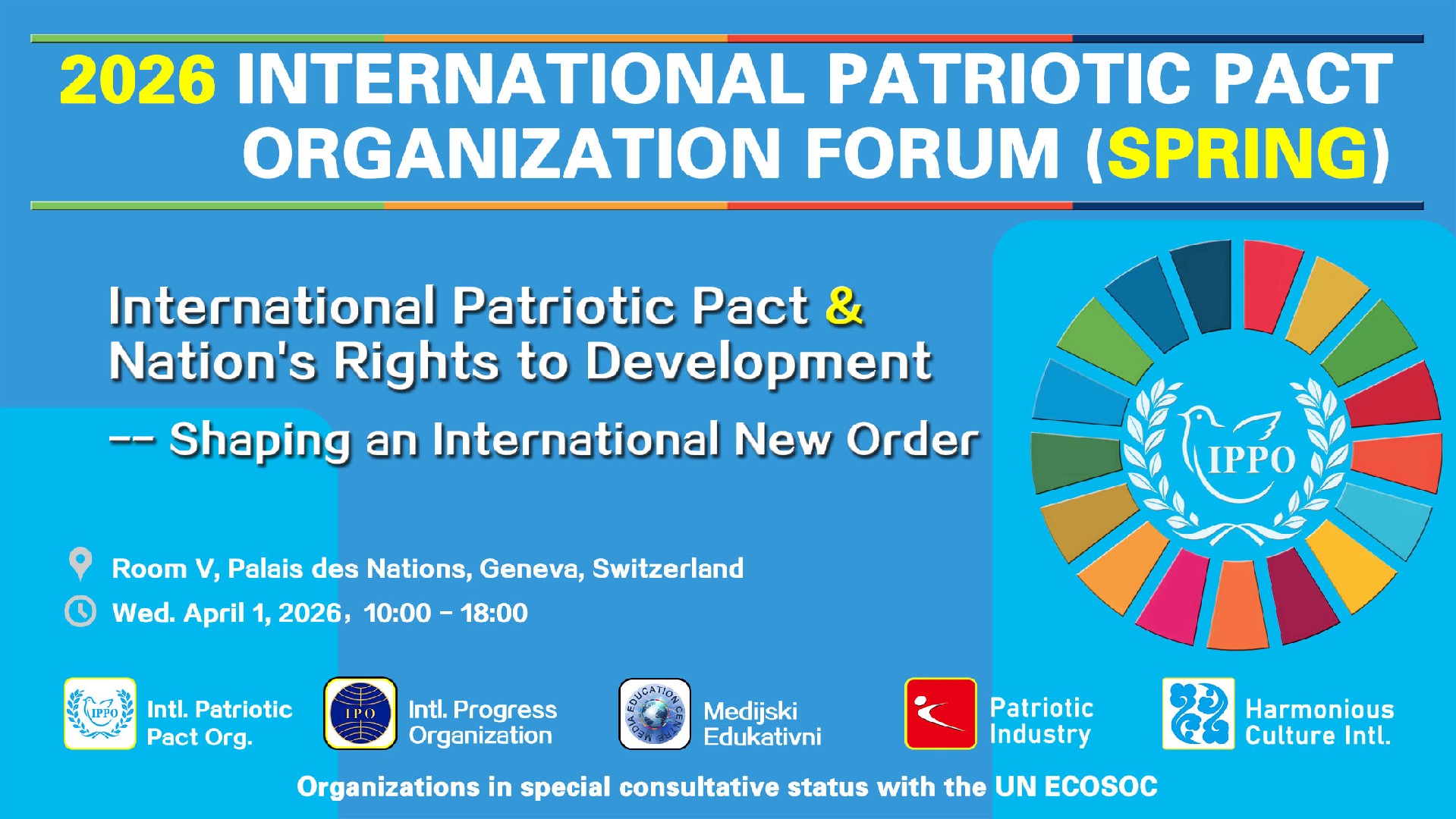
Notice of 2026 International Patriotic Pact Organization Forum(Spring)

Time:2026-01-21   Views:1363

In the era of continuously deepening globalization and complex and volatile international situations, international exchanges and cooperation have become increasingly crucial for maintaining world peace and development. To further promote the exchange and dissemination of international patriotic ideas and to deeply explore the positive impact of the International Patriotic Pact Organization (IPPO) initiative on world peace, after careful preparation by all parties, the 2026 IPPO Forum(Spring)will be held officially. The relevant matters regarding the forum are hereby notified as follows:

I. Forum Overview

1. Event Name: 2026 International Patriotic Pact Organization Forum

2. Theme: International Patriotic Pact and Nation’s Rights to Development - Shaping an  International New Order

3. Time: April 1, 2026, from 10 a.m. to 6 p.m.

4. Venue: Room V, United Nations Office at Geneva

5. Official Registration Link: https://indico.un.org/event/1021811/

II. Background and Significance of the Forum 

On October 1, 2025, the United Nations Office at Geneva witnessed the formal adoption of the "International Patriotic Pact" jointly drafted by more than 160 co-initiators of International Patriotic Pact Organizations. This pact emerged from a century of profound changes, where global governance dilemmas and development aspirations intersected: economic globalization was impacted by counter-trends, the "America First" policy exacerbated economic fragmentation, the expansion of American and European hegemony gave rise to exclusionary politics, and global industrial chains were shaken by geopolitical games; meanwhile, in the international order dominated by developed countries, developing countries' economic autonomy and resource control have been repeatedly eroded. Although the 1986 United Nations Declaration on the Right to Development clearly establishes the right to development as a human right, the wealth gap continues to widen in reality.

Against this backdrop, the 2026 IPPO Forum forged a consensus among global non-governmental organizations, reshaping the concept of "loving one's country without harming other nations’ interests" into a national consciousness for national development, and clarifying the "international dimension of patriotism" - that is, unifying the obligation to safeguard one's own development rights with respect for the sovereignty of other countries and participation in global cooperation. The pact establishes principles such as "nation’s rights to development are the foundation of human rights protection" and "sovereign equality and development rights equally important”, providing a new paradigm for addressing "hegemonic interference" and "development deficit". .

This forum is a further in-depth exploration of the concepts and practices related to the "International Patriotic Pact". It aims to deepen the international community's understanding of the "International Patriotic Pact" and the "Nation’s Rights to Development (Review/Mechanism)", explore their role in promoting international peace and national development, and jointly address global challenges. It holds significant practical importance.

III. Organizers and Co-organizers

1. Organizer: Shaanxi Patriotic Volunteer Association

2. Co-organizer: Co-Initiative Organizations of International Patriotic Pact Organization

Representatives of 270 non-governmental organizations from 65 countries worldwide, and co-founders of the International Patriotic Pact Organization play an important role in international affairs. Their active participation will bring diverse perspectives and rich experiences to the forum, jointly promoting the development of the international patriotic cause.

IV. Forum Agenda 

The agenda for this forum is set based on the mechanism of International Patriotic Pact Organization:

Item 1. Organizational and procedural matters: 

Clarify the organizational structure, operating rules, and various procedural arrangements of the forum to ensure its smooth progress and lay a solid foundation for the implementation of subsequent agendas.

Item 2. Expert report on nation’s rights to development:

Invite IPPO international experts to provide in-depth interpretation of the "Nation’s  Rights to Development Report" written/revised by them and approved by IPPO, providing professional theoretical guidance and practical suggestions for countries to safeguard nation’s rights to development and promote the development of the world's human rights cause.

Item 3. Other countries' development rights that require IPPO's attention: 

Analyze the development rights of countries that require IPPO's attention, as proposed by IPPO international experts, and implement the IPPO review work plan.

Item 4. Approval of IPPO Branches:

Review and approve applications submitted by international organizations for the establishment of IPPO country-specific branch, promote the construction of IPPO's global organizational network, and facilitate the dissemination and practice of international patriotic ideals in broader regions.

Item 5. IPPO Annual Report and Review Report:

This report provides a comprehensive review of IPPO's work achievements over the past year, summarizes experiences and lessons learned, reflects on and improves work through the review report, clarifies future development directions, and enhances the organization's work efficiency and influence.

Item 6. Initiative and Current Status of the "International Patriotic Pact":

This section will outline the development process of the "International Patriotic Pact" initiative, introduce its current implementation status, analyze existing issues and challenges, and provide ideas for further promoting national identity within the pact.

Item 7. Recognition of support and sponsorship:

Recognize institutions that provide support and sponsorship for the International Patriotic Pact initiative, express gratitude and recognition to them, and encourage more institutions to actively participate in the International Patriotic Pact cause, contributing to world peace and development.


We sincerely welcome all sectors of society to actively participate in and support this forum. Whether you are an expert or scholar in the relevant fields, a representative of a non-governmental organization, or a member of any social sector who cares about international affairs and loves world peace, you can find opportunities for exchange and cooperation at this forum. Let us work together to promote the development and practice of the international patriotic pact cause, and contribute our wisdom and strength to world peace and prosperity!

If you have any questions or need further information, please feel free to contact us.

Email: iad@unippo.org

International Patriotic Pact Organization

Shaanxi Provincial Patriotic Volunteer Association

January 16, 2026



Initiative of International Patriotic Pact

Time:2025-10-02   Views:1250

Joint Efforts to Establish a Peaceful and Just International New Order

Respected Representatives of NGOs and Relevant Institutions:

With a far-sighted vision and a spirit of selfless dedication, the leaders of over 240 non-governmental organizations (NGOs) from more than 60 countries (co-initiators of IPPO) proudly announce the official global release of the International Patriotic Pact under the shared vision of global peace and justice.

On October 1, 2025, representatives of co-initiators from 16 countries and nation’s rights to development experts convened at the United Nations Office at Geneva, where they reviewed and adopted the International Patriotic Pact (Draft).

Grounded in the principle of "loving one's own country without harming other nations’ interests" the pact clearly defines the responsibilities and boundaries of patriotic acts, emphasizing respect for national sovereignty, equality, mutual benefit, and peaceful coexistence.

 It aims to establish an international new order based on peace, cooperation, and mutual benefit.

Taking the International Patriotic Pact as our cornerstone, we propose to create a nation’s rights to development review mechanism to monitor whether countries' development practices infringe upon the sovereignty of others, harm their interests, or undermine global peace and stability.

We sincerely invite NGOs and governments worldwide to sign the pact and promote its values through education, cultural exchanges, and outreach activities. Let us unite and call for extensive support and participation from the United Nations to jointly establish a peaceful, just, inclusive, and orderly international new order.


Attachment: International Patriotic Pact


Sincerely,

President:Guowei CUI

International Patriotic Pact Organization (IPPO)                            
Shaanxi Patriotic Volunteer Association (CHINA)                     
Organization in Special Consultative Status with the UN ECOSOC

Initiative of International Patriotic Pact_EN.pdf


Initiative of International Patriotic Pact国际爱国公约倡议书_EN.jpg


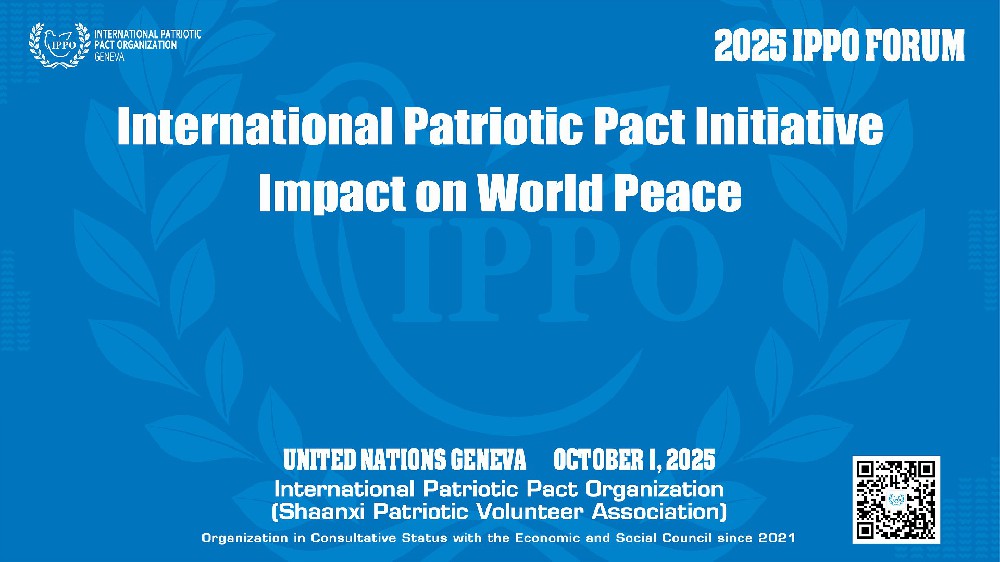
Notice on 2025 International Patriotic Pact Organization United Nations (Autumn) Forum

Time:2025-07-25   Views:1513

2025年IPPO秋季论坛_小.jpg

To whom it may concern,

In the current era of deepening globalization, international communication and cooperation are becoming increasingly important for maintaining world peace and development. In order to further promote the exchange and dissemination of international patriotic concepts, and to deeply explore the positive impact of the International Patriotic Pact Initiative on world peace, after careful preparation by all parties, the 2025 International Patriotic pact Organization (IPPO) United Nations (Autumn) Forum will be held grandly. The relevant matters of the forum are hereby notified as follows:

I、Forum Overview

1. Event Title: 2025 International Patriotic Pact Organization United Nations (Autumn) Forum

2. Forum Theme: The Impact of the International Patriotic Pact Initiative on World Peace

3. Time: October 1, 2025 10:00-13:00

4. Location: Conference Room XII, United Nations Office at Geneva

5. Forum registration: https://indico.un.org/event/1019304/

II、Background and significance of the forum

This forum is an important manifestation of the widely recognized Chinese patriotic concept of "Love one’s own country without harming other nations’ interests" in the international community. The collective recognition of this concept by over 150 non-governmental organizations from more than 50 countries around the world (including 55 non-governmental organizations with consultative status in the United Nations Economic and Social Council) fully demonstrates the influence of China's patriotic ideology on the international stage. At the same time, this is also an important practical exploration of the international patriotic pact initiative proposed by the Shaanxi Patriotic Volunteer Association and the IPPO Review Mechanism for Nations’ Rights to Development. The association has overcome numerous obstacles and actively responded to President Xi Jinping's speech on "enhancing China's ability to participate in global governance, focusing on strengthening its ability to formulate rules, set agendas, promote public opinion, and coordinate efforts" during the 35th collective study session of the Political Bureau of the Communist Party of China Central Committee on September 27, 2016. By holding this forum, it contributes to enhancing China's influence in global governance.

III、Host and Co-organizer

1. Host: Shaanxi Patriotic Volunteer Association

2. Co-organizers: Co organized by 25 non-governmental organizations from 14 countries including Switzerland, Serbia, Russia, India, Morocco, Mauritania, Cameroon, Nigeria, Pakistan, Benin, the Democratic Republic of the Congo, Ghana, Sri Lanka, and Kenya (including 13 with consultative status with the United Nations Economic and Social Council and 7 human rights organizations). These organizations from different countries and regions play an important role in international affairs, and their active participation will inject diverse perspectives and rich experience into the forum, jointly promoting the development of the international patriotic cause.

 IV、Forum Agenda

The agenda for this forum is set according to the mechanism of the International Patriotic Pact:

1. Organizational and procedural matters; Clarify the organizational structure, operating rules, and various procedural arrangements of the forum to ensure its smooth progress and lay a solid foundation for the subsequent agenda development.

2. Expert report on the nation’s right to development by the International Patriotic Pact Organization; Invite IPPO international experts to provide in-depth interpretation of the   Report of Nations’ Rights to Development, which has been compiled and approved by IPPO, in order to provide professional theoretical guidance and practical suggestions for countries to safeguard their nation’s rights to development and promote the development of the world human rights cause.

3. The status of the right to development in other countries that require IPPO's attention; Analyze the development rights situation of countries that require attention from IPPO international experts and implement the IPPO review work plan.

4. Approve IPPO branch offices; Review and approve the establishment applications of IPPO national branches submitted by organizations, promote the construction of IPPO's global organizational network, and promote the dissemination and practice of international patriotic concepts in a wider range of regions.

5. IPPO Annual Report and Review Report: comprehensively review the work achievements of IPPO in the past year, summarize lessons learned, reflect and improve the work through the review report, clarify future development directions, and enhance the organization's work efficiency and influence.

6. Advocacy actions and current situation of the International Patriotic Pact: Reviewing the development process of the advocacy actions of the International Patriotic Pact, introducing the current implementation status, analyzing the existing problems and challenges, and providing ideas for further promoting the national identity of the pact.

7. Certification of Supporting and Sponsoring Organizations: Certification of organizations that provide support and sponsorship for the International Patriotic Pact initiative, expressing gratitude and recognition for them, and encouraging more organizations to actively participate in the International Patriotic Pact initiative and contribute to world peace and development.

We sincerely welcome people from all walks of life to actively participate in and support this forum. Whether you are experts and scholars in related fields, representatives of non-governmental organizations, or people from all walks of life who are concerned about international affairs and love world peace, you can find opportunities for communication and cooperation in this forum. Let us join hands and work together to promote the development and practice of the international patriotic pact, and contribute our wisdom and strength to world peace and prosperity!

If you have any questions or need further information, please feel free to contact us at any time.

E-mail iad@unippo.org


International Patriotic Pact Organization

Shaanxi Patriotic Volunteer Association

July 25, 2025


Call for input for EMRTD study "Artificial Intelligence, Cultural Rights, and the Right to Development"

Time:2025-07-16   Views:1464

Background

The Human Rights Council, in its resolution 45/6, welcomed the first report (A/HRC/45/29) of the Expert Mechanism on the Right to Development, and requested it to implement the recommendations contained therein, including the preparation and submission to the Council thematic studies in the discharge of Expert Mechanism’s mandate. At its 8th session, the EMRTD outlined the thematic studies that it planned to submit to the Human Rights Council during the 2024-2026 cycle, including a study addressing artificial intelligence, regulation and the right to development.

Objectives

In light of evolving global dynamics affecting human rights, particularly those linked to rapid technological change, this study will specifically explore the implications, both positive and negative, of AI on cultural rights within the broader framework of the right to development.

AI technologies are already reshaping cultural landscapes, from creative production and dissemination to the accessibility of cultural content, language preservation, and participation in cultural life, to mention a few. At the same time, these developments give rise to significant risks including disinformation, algorithmic bias, and the erosion of cultural diversity risks that are enhanced by persistent digital divides.

Ensuring that AI is developed and deployed in a manner consistent with the right to development requires a rights-based approach, one that recognizes and protects, amongst others, cultural self-determination and participation in cultural life. However, against the backdrop of rapid technological advancement, fragmented and insufficient regulation at the national, regional, and global levels is unlikely to ensure the protection of cultural rights.

In these circumstances, this questionnaire aims to:

• Gather concrete examples of how AI is impacting cultural rights and access to development;

• Identify risks, including discrimination, censorship, or appropriation, arising from AI applications;

• Understand the scope and role of national, regional, and international regulatory approaches;

• Assess the adequacy of current institutional frameworks in addressing these challenges;

• Explore feasible policy and legal instruments, including regulatory frameworks, mitigation strategies, and guiding principles.

Submissions are invited from a wide range of stakeholders, including Member States and regional groups, civil society organisations; academic and research institutions; private sector entities, especially those involved in technology development; independent experts, artists, and cultural practitioners.

Key questions and types of input/comments sought

1. In your opinion, what, if any, are the potential benefits of Artificial Intelligence (AI) for cultural rights in the context of the right to development? You may, for instance, consider AI’s impact on development, cultural participation, cultural diversity (including language preservation, artistic creation and expression, access and participation in science, academic and scientific freedom, and the protection of moral and material rights of authors and creators)?

2. Can you provide any specific real-life examples where AI has already enhanced the enjoyment of cultural rights when pursuing the right to development?

3. To what extent, if any, do existing digital divides deprive developing and least developed countries from reaping those benefits?

4. Can you provide any specific real-life examples involving the impacts of such digital divides on the enjoyment of cultural rights when pursuing the right to development?

5. What are the main risks posed by and drawbacks already identified of Artificial Intelligence, including, amongst others, generative AI, to cultural rights in pursuing the right to development?

6. In addition to the above, please set out your views on the following potential AI risks and drawbacks in terms of how they relate to cultural rights:

(i) Algorithmic bias 
(ii) Discrimination by automatic moderation and censorship 
(iii) AI-generated disinformation 
(iv) AI systems going wrong
(v) Appropriation of cultural production or dissemination 
(vi) Artistic, academic, and scientific freedom and development
(vii) Creative industries
(viii) Protection of authors’ moral and material interests and cultural diversity, including linguistic diversity

7. Do those risks and drawbacks disproportionately affect any particular category of individuals or groups of people when pursuing their right to development? Please explain below.

8. What do you believe might be the long-term effects of AI use on cultural rights and, in that context, the future of the right to development, including cultural self-determination?

9. How can cultural rights be protected in the era of rapid AI development ? You may, for example, consider prevention and mitigation.

10. Do you think regulating AI would be an effective way to protect cultural rights when pursuing the right to development?

11. If so, what kinds of AI uses or tools should be regulated, how, and by whom?

12. Is self-regulation of technology companies that develop AI sufficient to protect cultural rights? If not, why not?

13. Do you envisage any disadvantages to the protection of cultural rights and the right to development if binding AI regulations were in place?

14. Is the current institutional framework in your country equipped to deal with the new AI challenges to cultural rights? If not, what are some of its blind spots or shortcomings?

15. Are regional agreements equipped to deal with the new AI challenges to cultural rights that underpin or are motivated by the right to development? If not, in what ways do they fall short?

16. Which do you think would be more effective—a binding global treaty on AI regulation and human rights or domestic regulation on the same issue?

17. What are the potential barriers to developing and implementing a binding global treaty on AI regulation and human rights?

18. What do you think about the potential benefits of Guiding Principles on AI regulation and cultural rights, akin to those on Business and Human Rights? Would such an instrument be useful, especially in the absence of domestic regulation?

19. Please share any other comments.

How inputs will be used?

Input directly relevant to the study may be cited in the study report. Contributors may choose to opt out of having their submissions cited. If contributors prefer their input to remain confidential, they should specify this in their submission. All confidential input will be treated as such.

Next Steps

Input/comments may be sent by e-mail. They must be received by 28 November 2025 00:00 (Geneva time).

Kindly submit your contributions preferably in English or accompanied by a translation into English, in MS Word or compatible format.

Email address: iad@unippo.org

Email subject line: Input for EMRTD study "Artificial Intelligence, Cultural Rights, and the Right to Development"

Accepted file formats:
Word, PDF


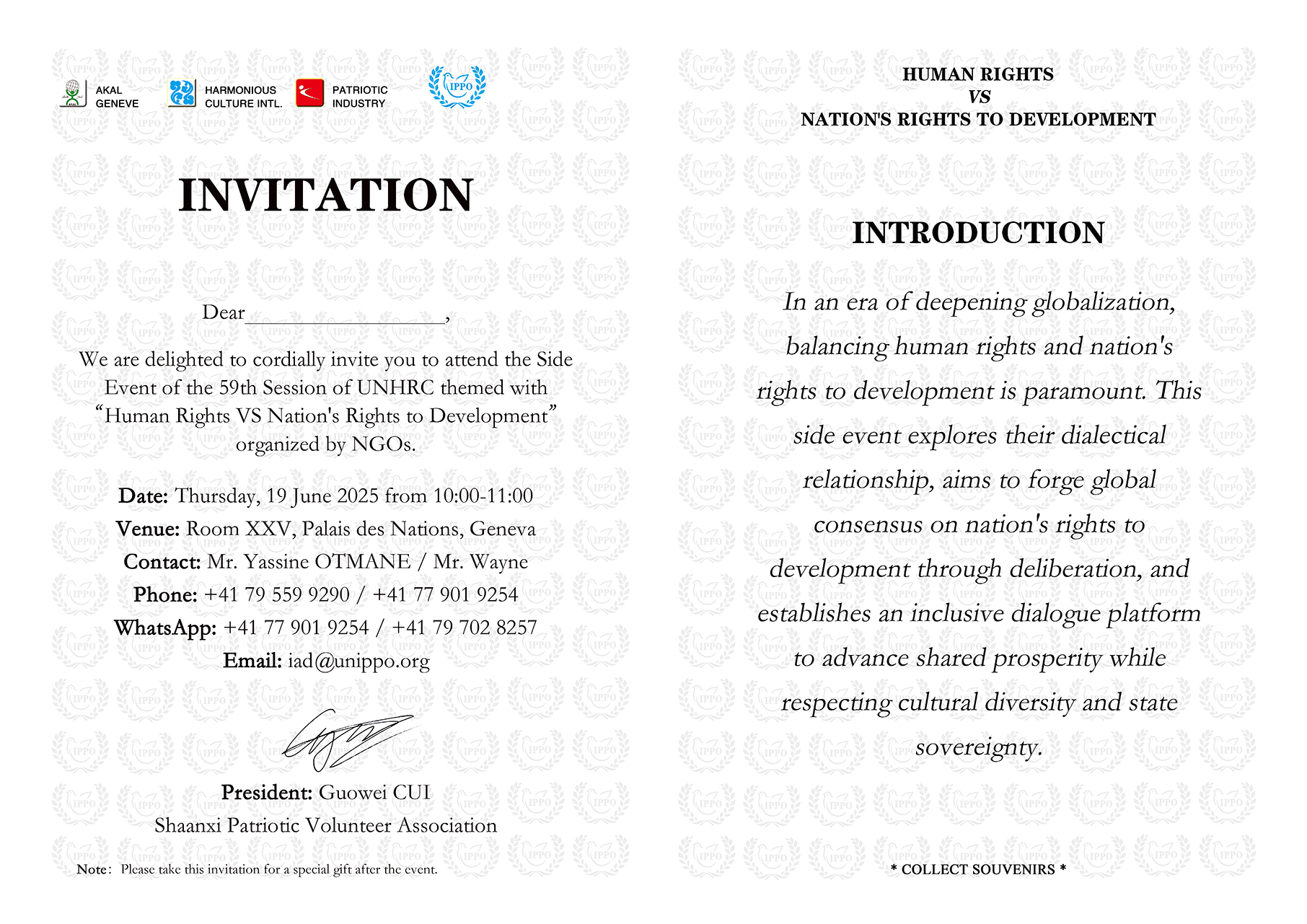
Announcement: Side Event on "Human Rights VS Nation's Rights to Development" at the 59th Session of the UNHRC

Time:2025-06-13   Views:1437

Introduction

In an era of deepening globalization, balancing human rights and the right to national development is of utmost importance. This seminar explores the dialectical relationship between them, aiming to reach a global consensus on the right to national development through deliberations and establish an inclusive dialogue platform that promotes common prosperity while respecting cultural diversity and national sovereignty.

Theme

The theme of this conference is "Human Rights VS Nation's Rights to Development."

Topics

  1. Legal Positioning of the Nation's Rights to Development and the International Patriotic Pact Initiative

    • Analysis of the legal positioning of the "Nation's Rights to Development"

    • Exploration of the practice and pathways of the International Patriotic Pact Initiative

  2. The Intrinsic Unity of National Sovereignty and the Right to Development

    • Analysis of the constraints imposed by technological hegemony and financial monopolies on the industrial upgrading of developing countries

    • Discussion of the balance mechanism for the right to development in intellectual property protection and technology transfer

  3. International Mechanism Innovation and the Safeguarding of the Right to Development

    • The role of the International Patriotism Pact initiative in promoting a balanced development of human rights

    • NGOs' efforts in advancing the reform of the global human rights governance system

Objectives

  1. Theoretical Deepening: Clarify the attributes of the nation's rights to development and the subjects of obligations, and enhance the theoretical dialogue on the nation's rights to development and the International Patriotic Pact Initiative.

  2. Practical Orientation: Formulate development approaches that balance human rights standards with the realities of the nation's rights to development.

  3. Mechanism Innovation: Promote the construction of a more inclusive international dialogue platform and improve the monitoring and evaluation system for the nation's rights to development.

  4. Consensus Building: Continue to advance the initiative of the "International Patriotic Pact" (draft), clarifying phased goals and action plans.

Time

10:00 AM - 11:00 AM, June 19, 2025

Venue

Room XXV, United Nations Office at Geneva

Organizer

Shaanxi Patriotic Volunteers Association* (China)

Co-Organizers

  • Forum méditerranéen pour la promotion des droits du citoyen* (Morocco)

  • Green and Better World* (Cameroon)

  • Smiles Africa International Youth Dev. Initiative* (Nigeria)

  • Association du Développement et de la Promotion de Droits de l'Homme* (Mauritania)

  • Africa Culture Internationale (Human Rights)* (Senegal)

  • Medijski Edukativni Centar* (Serbia)

  • International Patriotism Pact Organization (Switzerland)

  • Union Farms of Africa* (Cameroon)

List of Speakers and Their Topics

  • Cui Guowei, President of the Shaanxi Patriotic Volunteer Association* (China): "Promoting the Synergistic Development of Human Rights and the Nation's Rights to Development through the 'International Patriotic Pact'"

  • Professor Yi Bo, School of Law, Southeast University* (China): "The Legal Positioning of the Nation's Rights to Development and the International Patriotic Pact Initiative"

  • Yuan ZHAO, President of the Swiss Fujian Association (Switzerland)

  • Mr. Yassine Otmane, Vice-President of the International Patriotic Pact Organization (Switzerland)

  • Mourad lafkihen, President of the Forum méditerranéen pour la promotion des droits du citoyen* (Morocco)

  • Michael Amba Ngwa, President of Green and Better World* (Cameroon)

  • Purpose Osamwonyi Iserhienrhien, Executive Director of Smiles Africa International Youth Dev. Initiative* (Nigeria)

  • Hawa Sidibe, President of the Association du Développement et de la Promotion de Droits de l'Homme* (Mauritania)

  • Dr. Dianko Lamine, President of Africa Culture Internationale (Human Rights)* (Senegal)

  • Miomir Rajcevic, President of Medijski Edukativni Centar* (Serbia)

  • Ajinga Justin Tanyi, President of Union Farms of Africa* (Cameroon)


Side event of the United Nations Economic and Social Council's High-level Political Forum on Sustainable Development: "Building a Shared Future for the Earth"

Time:2025-03-11   Views:1291

Against the backdrop of globalization, the Shaanxi Patriotic Volunteer Association proposed the international patriotic concept of "love our own country, cannot sacrifice the interests of other countries" at a UN conference, emphasizing that national development should respect the sovereignty and interests of other countries to achieve win-win cooperation. This concept has been widely recognized by the international community and has received signed support from over 120 non-governmental organizations in 40 countries worldwide.

On June 20, 2024, the "2024 International Patriotic Pact Organization Forum" was successfully held at the United Nations Office at Geneva, attracting support and participation from 198 initiators from 39 countries across five continents. From Monday, July 8th to Wednesday, July 17th, 2024, the United Nations High-level Political Forum on Sustainable Development (HLPF) will be held under the auspices of the Economic and Social Council. With the approval of the HLPF Secretariat, the Shaanxi Patriotic Volunteer Association will host a parallel session titled "Building a Shared Earth Village: Exploring New Paths for Sustainable Development and Global Governance" to promote the international recognition and practice of the international patriotic concept. The conference will delve into topics such as patriotism and international responsibility, global governance and fairness and justice, sustainable development and win-win cooperation, aiming to deepen the international community's understanding and identification with this concept, facilitate cooperation among countries in the fields of sustainable development and global governance, promote reforms in the global governance system, and provide new ideas for global sustainable development. We look forward to jointly building a peaceful, prosperous, and sustainable Earth village through this conference.

I. Conference Theme

Building a Shared Earth Village: Exploring New Paths for Sustainable Development and Global Governance

II. Specific Topics

1. The Establishment of the International Patriotic Concept and the Construction of a New International Order

Research Direction: Analyze how the international patriotic concept influences the evolution of international relations and explore its role in building a more harmonious and stable new international order.

2. In-depth Research on International Cooperation Mechanisms in the Face of Global Challenges

Research Content: Delve into the necessity, current status, and deepening strategies of international cooperation mechanisms in the context of global challenges, aiming to form an effective synergy to address common issues.

3. Case Study on International Patriotism: Practice and Inspiration

Paper Focus: Through specific case studies, analyze the effectiveness of international patriotism in different countries and regions, extract innovative ideas, and provide learnable experiences for other countries.

4. Strategies and Significance of Establishing a Long-term Mechanism for the Review of the International Patriotic Pact Organization

Research Topic: Explore how to establish a long-term mechanism to facilitate the review by the International Patriotic Pact Organization of countries worldwide (reviewing whether countries, while developing themselves, harm the sovereignty of other countries), and analyze the importance of such a mechanism for strengthening international cooperation and promoting common development.

III. Conference Time

July 17, 2024, 14:00-17:00 (Equipment debugging from 14:00-16:00, conference extended to 18:00)

IV. Conference Location

Beijing Preparatory Office of the International Patriotic Pact Organization (IPPO)

V. Contact Information

Contact Person: Wang Junzhan

Telephone: 010-59258698, 13691331956

Email: iad@sxpva.org

VI. Conference Agenda

14:00-15:50 Equipment debugging phase

15:00-16:00 Preliminary start of the conference

16:00-16:05 Welcome speech

16:05-16:10 Yi Bo (Associate Professor), School of Law, Southeast University

16:10-16:15 Li Tianwen (President), China Welfare Association Learn from Lei Feng Fund Management Committee

16:15-16:30 Adéyemí Oludele Ayeni (Nigeria), Gems Heart one Love Foundation

16:30-16:50 Wang Yi, Executive Chairman, China Dream 35 Strategic Engineering Organizing Committee

16:50-17:05 Liu Dian, Associate Researcher, China Institute, Fudan University

17:05-17:20 Ma Cheng (Professor), Executive Director, Human Rights Research Center, Northwest University of Political Science and Law

17:20-17:25 Sun Shaoyong (Professor), School of Marxism, Northwest Polytechnical University

17:25-17:30 Chen Yufu, China Red Culture Party Building Network

17:30-17:35 Li Xiaolong (Lawyer & Secretary-General), Xi'an Silk Road Maker Technology Industry Association

17:35-17:40 Lucy Mumbi Shahenza (Kenya), Addisoon International

17:30-17:40 Byaruhanga Crispus (Uganda), Munanxi Green Initiative Organization

17:40-17:55 BABATUNDE DAMIOLA (Nigeria), Youth Transformers Foundation

17:55-18:00 Conference ends

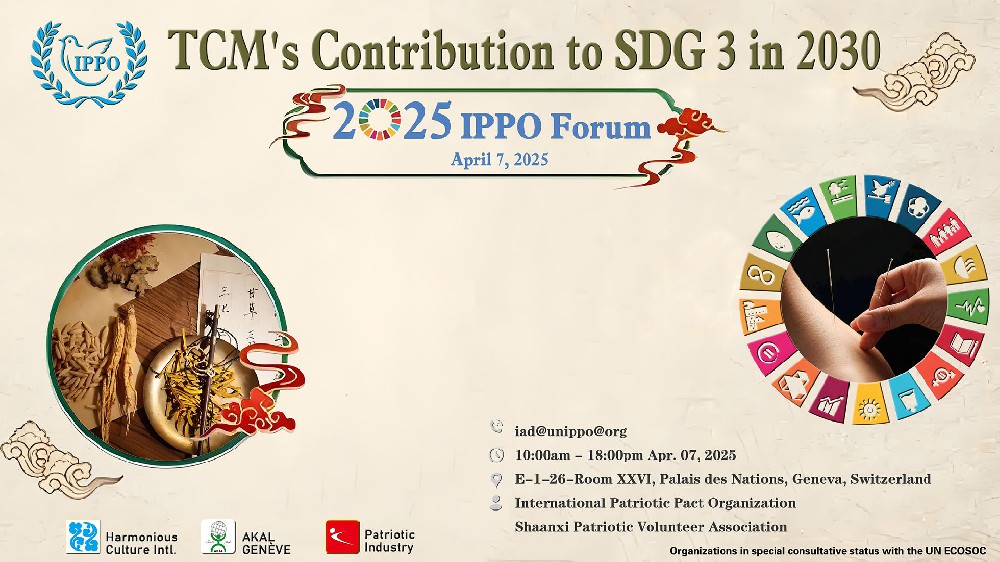
2025 International Patriotic Pact Organization United Nations Forum:Contributions of Traditional Chinese Medicine to SDG3 of 2030 Agenda

Time:2025-03-02   Views:1183

Guiding Unit: International Patriotic Pact Organization

Host Unit: Shaanxi Patriotic Volunteer Association

Background:

The Sustainable Development Goals (SDGs), abbreviated as SDGs, are the 17 global development goals formulated by the United Nations to guide global development efforts from 2015 to 2030. Among them, Goal 3: Ensure healthy lives and promote well-being for all at all ages, is crucial for sustainable development, as it concerns the right to life and survival of every individual. Countries need to redouble their efforts to eradicate a series of diseases and address various persistent and emerging health issues.

To this end, the 72nd session of the United Nations General Assembly resolved to designate December 12th as International Universal Health Coverage Day, emphasizing the importance of building robust and resilient health systems and the necessity of achieving universal health coverage.

In light of the successful forum on "China's Contribution to the 2030 Sustainable Development Goals" held by the International Patriotic Pact Organization Shaanxi Patriotic Volunteer Association at the United Nations in Geneva on June 20, 2024, which received widespread attention and praise, this forum is specially planned to further demonstrate the contributions of traditional Chinese medicine in promoting global health security and advancing the 2030 Sustainable Development Goals.

Theme:

Contributions of Traditional Chinese Medicine to SDG 3 of 2030 Agenda

Objectives:

1. To showcase the unique roles and effectiveness of traditional Chinese medicine in promoting universal health, disease prevention, treatment, and rehabilitation.

2. To analyze how traditional Chinese medicine supports the achievement of the 2030 Sustainable Development Goals, particularly in the areas of health, poverty reduction, cultural heritage, and innovation.

3. To promote international understanding and recognition of traditional Chinese medicine and facilitate its application and cooperation globally.

4. To strengthen exchanges and cooperation among governments, international organizations, non-governmental organizations, academia, and the private sector to jointly promote the development of global health security.

5. To advance the construction and cooperation of the "China-Switzerland Traditional Chinese Medicine Center (Geneva)" as a special project for international cooperation in traditional Chinese medicine.

Time and Location:

Time: March X, 2025, 10:00-18:00

Location: A conference room at the United Nations Office at Geneva

Participants:

Folk inheritors of traditional medicine (including acupuncture, tui na, and acupressure experts)

Experts and scholars in traditional Chinese medicine

Representatives of medical institutions and organizations

Representatives of related pharmaceutical industry enterprises

Representatives of international health organizations

Agenda:

1. Opening Ceremony and Addresses (10:00-10:30)

ž   The host introduces the background, objectives, and hosting units of the forum.

ž   A welcoming speech delivered by the head of the International Patriotic Pact Organization.

ž   An introduction to the history, current status, and significance of traditional Chinese medicine for global health security.

ž   Addresses from guests congratulating and expressing expectations for the forum.

2. Keynote Speeches (10:30-12:00)

ž   Inviting renowned domestic and foreign experts, scholars, and government representatives to speak on the roles of traditional Chinese medicine in promoting universal health, disease prevention, treatment, and rehabilitation.

ž   Analyzing how traditional Chinese medicine can be combined with modern medicine to jointly address global health challenges.

ž   Discussing the future development trends of the integration of traditional Chinese medicine and modern medicine, especially the incorporation of special therapies into modern medical systems.

3. Lunch and Break (12:00-14:00)

ž   A free lunch providing an opportunity for participants to exchange ideas and rest.

4. Practical Demonstrations and Exchanges (14:00-16:30)

ž   Sharing successful cases of traditional Chinese medicine in poverty reduction, cultural heritage, and innovation.

ž   Demonstrating the unique role of traditional Chinese medicine in responding to public health emergencies.

ž   Sharing expertise and facilitating international information exchange and sharing in the field of traditional Chinese medicine and its special therapies.

5. Achievements Exhibition (16:30-17:30)

ž   Display of traditional Chinese medical instruments.

ž   Summarize and review the forum, emphasizing the significant role of traditional Chinese medicine (TCM) and its special therapies in global health governance.

6. Closing Ceremony (17:30-18:00)

ž   Closing Remarks: Review the forum's achievements and look forward to the future prospects of traditional Chinese medicine in global health security and sustainable development.

ž   Souvenir Distribution: Express gratitude to the guests and contributors to the forum by distributing souvenirs.

Note: During the forum, an exhibition area will be set up to display books, equipment, research results, and other materials related to traditional Chinese medicine and its special therapies, allowing participants to gain a more intuitive understanding of the profound wisdom of traditional Chinese medicine.


2024 International Patriotic Pact Organization UN Forum

Time:2025-03-02   Views:1220

在联合国成立79周年之际,国际爱国公约组织将举办联合国论坛,以“国际爱国主义理念:探索可持续发展与全球治理的新路径”为主题,倡导“爱自己的国家,不能牺牲别国的利益”的原则。

2025年IPPO秋季论坛_小.jpg

在全球化背景下,陕西省爱国志愿者协会在联合国会议上提出了“爱自己的国家,不能牺牲别国利益”的国际爱国理念,强调国家发展应该尊重他国的主权和利益,实现互利共赢。这一理念得到了国际社会的广泛认可,来自40个国家的120多个非政府组织签署了支持。2024年6月20日,“2024国际爱国公约组织论坛”在联合国日内瓦办事处成功举办,吸引了代表五大洲39个国家的198位发起人的支持和参与。

在国际和平日——“9月21日”之后,联合国鼓励各组织举办活动。陕西省爱国志愿者协会经国际爱国公约组织授权,将主办以“国际爱国主义理念:探索可持续发展与全球治理新路径”为主题的“国际爱国公约组织联合国论坛”。论坛旨在促进国际社会对国际爱国主义理念的认可和实践。讨论将围绕爱国主义与国际责任、全球治理与公平正义、可持续发展与互利合作等议题展开,旨在加深国际社会对这一理念的理解和认可,促进各国在可持续发展和全球治理领域的合作,推动全球治理体系的改革, 为全球可持续发展提供新思路。我们期待通过这次会议,共同建设一个和平、繁荣、可持续的地球村。

一、论坛主题

国际爱国理念:探索可持续发展与全球治理的新路径。

二、具体主题

1.国际爱国主义理念的确立和国际关系新秩序的构建。

研究方向:分析国际爱国主义理念如何影响国际关系的演变,探讨其在构建更加和谐稳定的国际新秩序中的作用。

2. 深入研究在全球挑战下深化国际合作机制。

研究内容:深入探讨在全球挑战背景下深化国际合作机制的必要性、现状和策略,旨在形成有效的协同效应,解决共同问题。

3. 国际爱国主义案例研究:实践与见解。

论文重点:通过具体案例分析不同国家和地区国际爱国主义在实践中的有效性,提炼创新思路,提供其他国家可以借鉴的经验教训。

4. 建立国际爱国公约组织长期审查机制的战略和意义。

研究主题:探讨如何建立长效机制,便利国际爱国公约组织对世界各国进行审查(审查各国在发展自己的同时,是否牺牲了他国的民族权利),并分析了这种机制在加强国际合作和促进共同发展方面的重要性。

三、时间

2024年10月24日 16:00-18:00

四、地点

国际爱国公约组织(IPPO)北京筹备办公室

五、联系方式

联系人:王俊展

电话: +86 10-59258698, 13691331956

电子邮件:iad@sxpva.org